Analog Marketing for Nonprofits: Reaching Gen Z

Recently, I rewatched Guardians of the Galaxy Vol. 2 and Vol. 3 back-to-back.
What struck me wasn’t the explosions. It wasn’t the sarcasm. It wasn’t even the emotional trauma arcs (though… we could talk).
It was the music.
An old-school cassette. A Walkman. A soundtrack rooted in another era—playing inside a hyper-digital, CGI-saturated universe.
That contrast is doing something important.
And if you work in a small nonprofit arts organization right now, you should be paying attention because we’re in a similar cultural moment.
Young audiences—Gen Z and Millennials especially—are living inside the most algorithm-driven era in history. And yet? They’re buying vinyl. Deleting apps. Making lunch dates instead of content. Romanticizing brick phones.
They’re craving analog in a digital galaxy.
And the question for us isn’t, “How do we jump on that trend?”
It’s:
What does this actually mean for our work—and our capacity?
Let’s talk about it.
The Cassette Tape in a CGI World
In Guardians, the music works because it’s personal. It’s inherited. It’s memory. It’s grounding. It’s not there to be retro-cute. That’s the first lesson.
If you’re thinking about “analog marketing” for your organization, pause before you order 500 vinyl-themed stickers.
Nostalgia without emotional truth feels like set dressing.
Right now, younger audiences aren’t nostalgic for aesthetics alone. They’re nostalgic for:
Slower connection
Physical artifacts that hold memory
Less performance, more presence
Experiences that feel embodied instead of optimized
And here’s the simple truth of the matter:
We already provide that.
Live performance.
Shared space.
Programs in hand.
Silence before a downbeat.
The arts are inherently analog.
The issue isn’t that we’re too analog. The issue is that sometimes our marketing language still sounds like we’re competing with the algorithm instead of offering an alternative to it.
Phygital: Not a Gimmick, a Bridge
You’ll hear the word “phygital”—physical + digital—thrown around in marketing circles.
For small arts organizations, that can sound exhausting.
But here’s what it really means in practice: Use digital tools to invite people into physical, meaningful experiences.
That’s it.
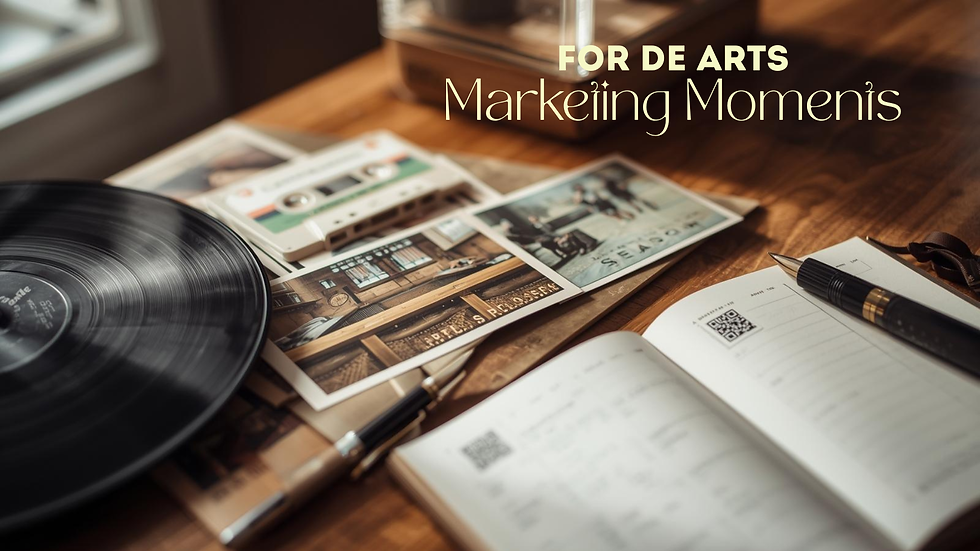
A beautifully designed season postcard with a QR code that leads to a behind-the-scenes rehearsal clip.
A printed planner-style event calendar that people actually keep.
A tangible membership welcome kit that doesn’t feel like corporate swag.
Digital isn’t the enemy. In Guardians, the cassette doesn’t reject technology—it coexists with it.
Your audience still buys tickets online. They still text friends about shows. They still discover you digitally.
But they don’t want to feel like every interaction is a sales funnel.
Phygital, done well, feels like an invitation—not an ad.
Not Every Organization Is a Guardian
Here’s the discernment piece.
Just because “offline is cool” doesn’t mean it’s your strategy.
Small teams cannot afford to chase trends the way Marvel can chase box office numbers.
Before you pivot toward analog aesthetics, ask:
Is this actually our audience?
Are we solving a real tension they feel?
Can we execute this well with our current capacity?
Does this deepen belonging—or just look clever?
If your audience skews older and already prefers print, that’s not a trend. That’s alignment.
If your audience is 25–40 and digitally fatigued, there may be room to lean into tangible experiences more intentionally.
But discernment is leadership.
Trends are signals. Not marching orders.
The Cool Factor of Being Unreachable
One of the most interesting shifts happening right now is this:
Being offline has status.
In Vol. 3, there’s a recurring thread about identity—about who you are without the noise, without the performance, without the expectation.
Young audiences are wrestling with something similar. Social platforms feel like pressure platforms. Constant comparison. Constant selling. Constant visibility.
And when something feels overexposed, people move toward what feels rare. Presence is rare. Undivided attention is rare. Silence is rare.
That’s what we offer.
Instead of trying to be louder online, what if we positioned our organizations as places of relief?
Not anti-technology. Not moralistic.
Just grounded.
“Come sit in a room with other humans. Let something unfold in real time.”
That’s not retro. That’s restorative.
Capacity Check: You Don’t Need a Franchise Budget
Marvel can redesign a universe every few years.
You cannot.
And you don’t need to.
If you’re a team of three wearing seven hats each, your move is not a sweeping nostalgia rebrand.
Your move might be:
Upgrading one print piece to feel intentional instead of disposable
Designing a lobby experience that encourages people to be present
Reintroducing collectible ticket stubs
Hosting one analog-inspired community event (letter writing, zine-making, listening party tied to programming)
Small shifts. Thoughtful execution.
The goal isn’t spectacle. It’s resonance.
A Moment of Truth
Here’s the part that might sting a little:
Some of us have become so focused on digital metrics that we’ve forgotten how to measure felt experience.
Not everything meaningful will show up in engagement numbers.
You won’t always see “analog relief” in a dashboard.
But you might see:
Audiences lingering in the lobby
Programs taken home instead of being left behind
Conversations that continue after the curtain falls
People returning because it felt different
Our audiences are constantly evolving, and our organizational survival requires us to evolve as well.
But evolution doesn’t mean abandoning who we are.
In Guardians, the music matters because it anchors the characters to something human in the middle of chaos.
For small nonprofit arts organizations, maybe the work isn’t to become more digital.
Maybe it’s to remember that we’ve always been the cassette tape in the CGI galaxy.
And to lean into that—intentionally, sustainably, and without overextending ourselves.
Sit with this:
How can your orchestra, gallery, theatre, or dance company become a place where digital-weary audiences experience something grounded, tactile, and real—without burning out your team in the process?
Start there.
If this conversation stirred something for you—especially around how easily nostalgia can tip from meaningful to manufactured—I put together a practical slide deck for small arts teams: “10 Things to Avoid When Conducting Nostalgia Marketing.” It’s honest. It’s capacity-aware. And it’s built specifically for nonprofit organizations that don’t have time (or budget) to get this wrong.
If that would be useful to you, you can download it here: https://www.fordearts.com/nostalgia-marketing-download
No fluff. Just clarity, you can use.


Comments